An Incomplete Field Guide to the Bengali Gentleman: The Bhadralok in His Native Habitat!


(With Footnotes, Digressions, and Appropriate Melancholy)
The Bhadralok (homo bengalicus respectable) is a creature of remarkable consistency. Across one hundred and fifty years of seismic historical change — the fall of empire, the horror of Partition, the rise and collapse of the Left Front, the inauguration of seventeen new flyovers that remain unfinished — he has adapted not at all. This is his greatest achievement, and he is very proud of it.
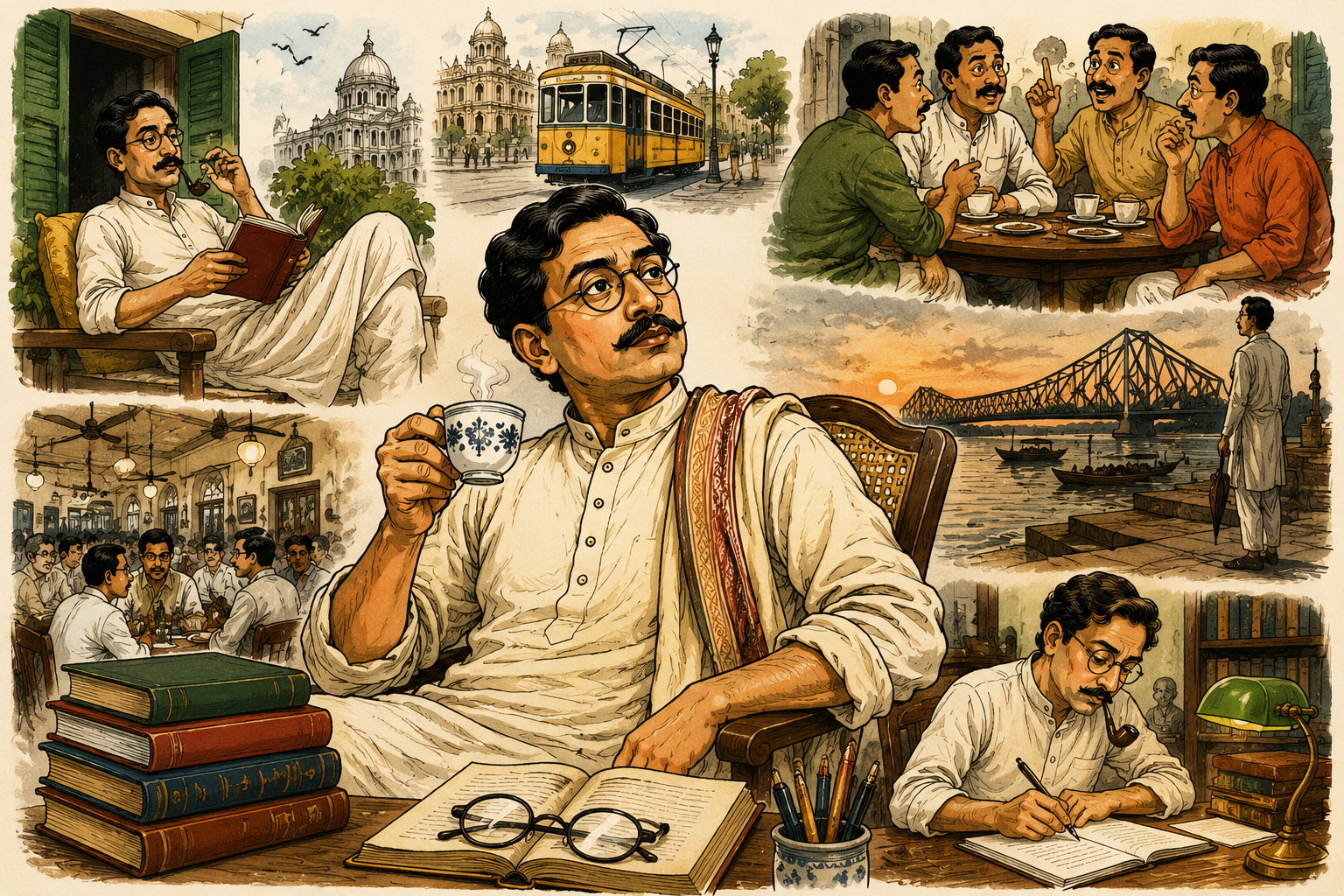
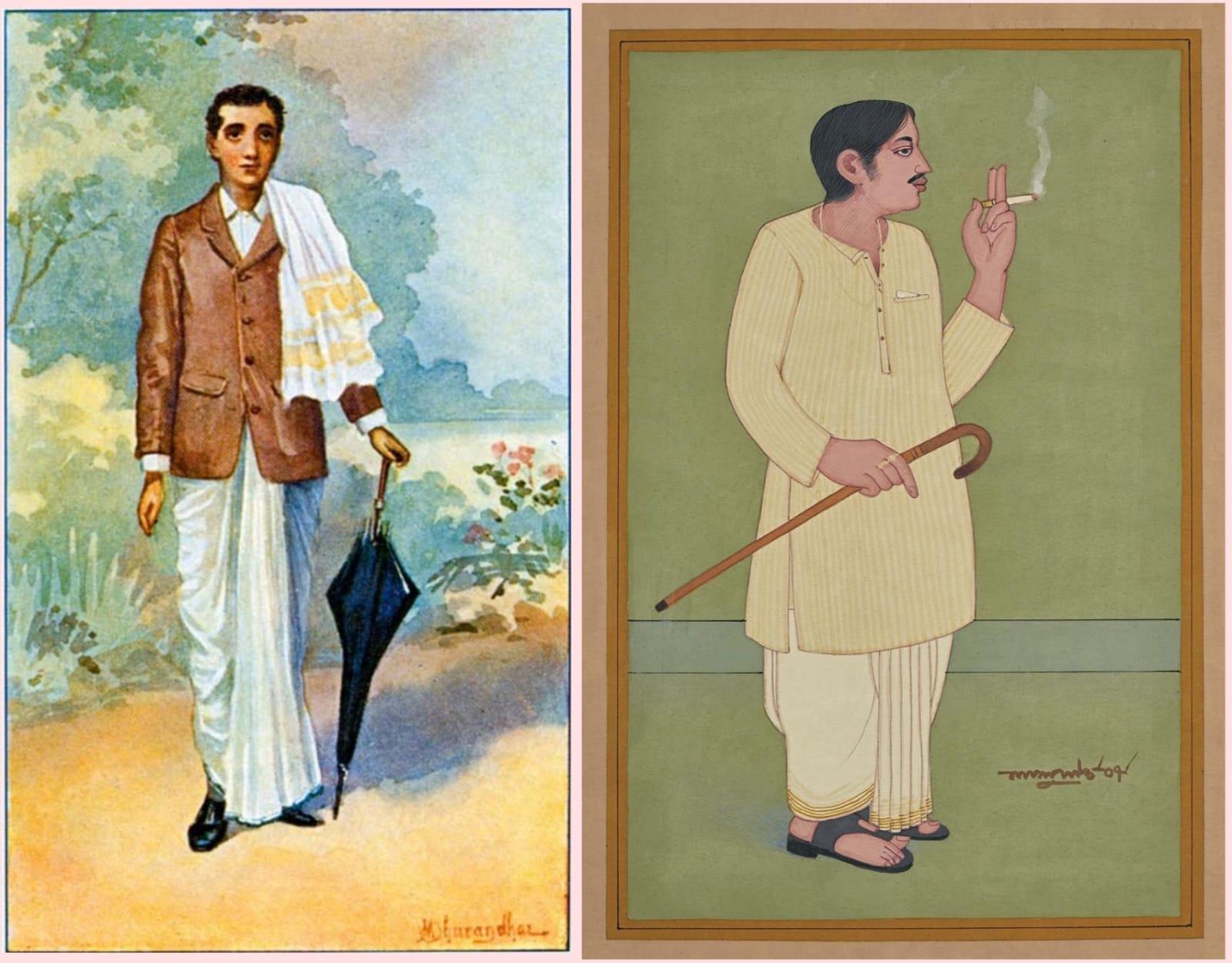
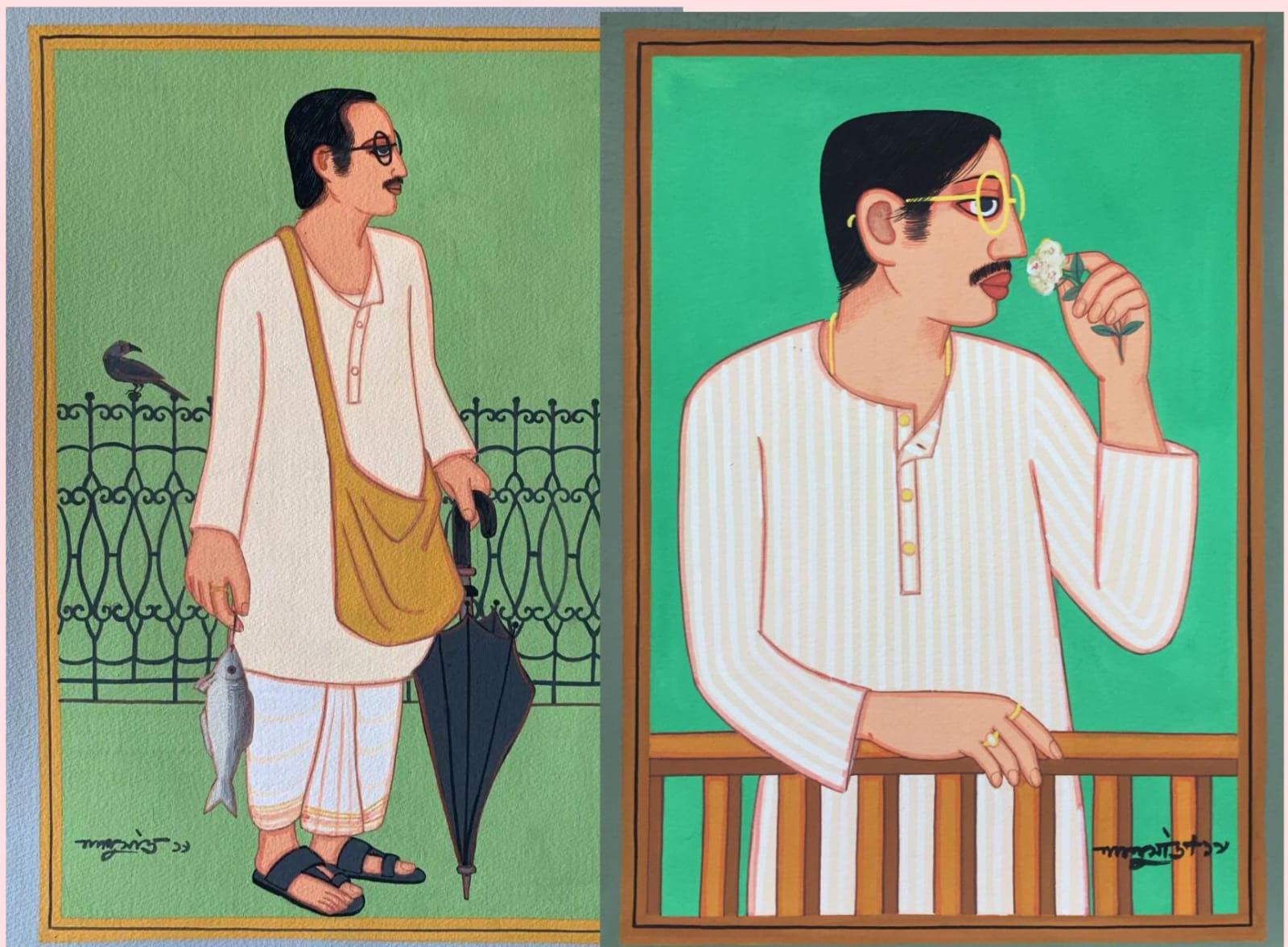
He may be identified in the field by the following characteristics: a cotton kurta that suggests learning, wire-rimmed spectacles that confirm it, and an expression of pained intelligence that implies the world has, once again, failed to meet his standards. He carries a jute bag. The jute bag contains a dog-eared copy of something — Tagore, Camus, a back issue of Desh magazine — that he has been carrying for eleven years without finishing.
The Bhadralok has opinions the way other people have furniture: accumulated over generations, impossible to move, slightly uncomfortable, and absolutely central to his identity.
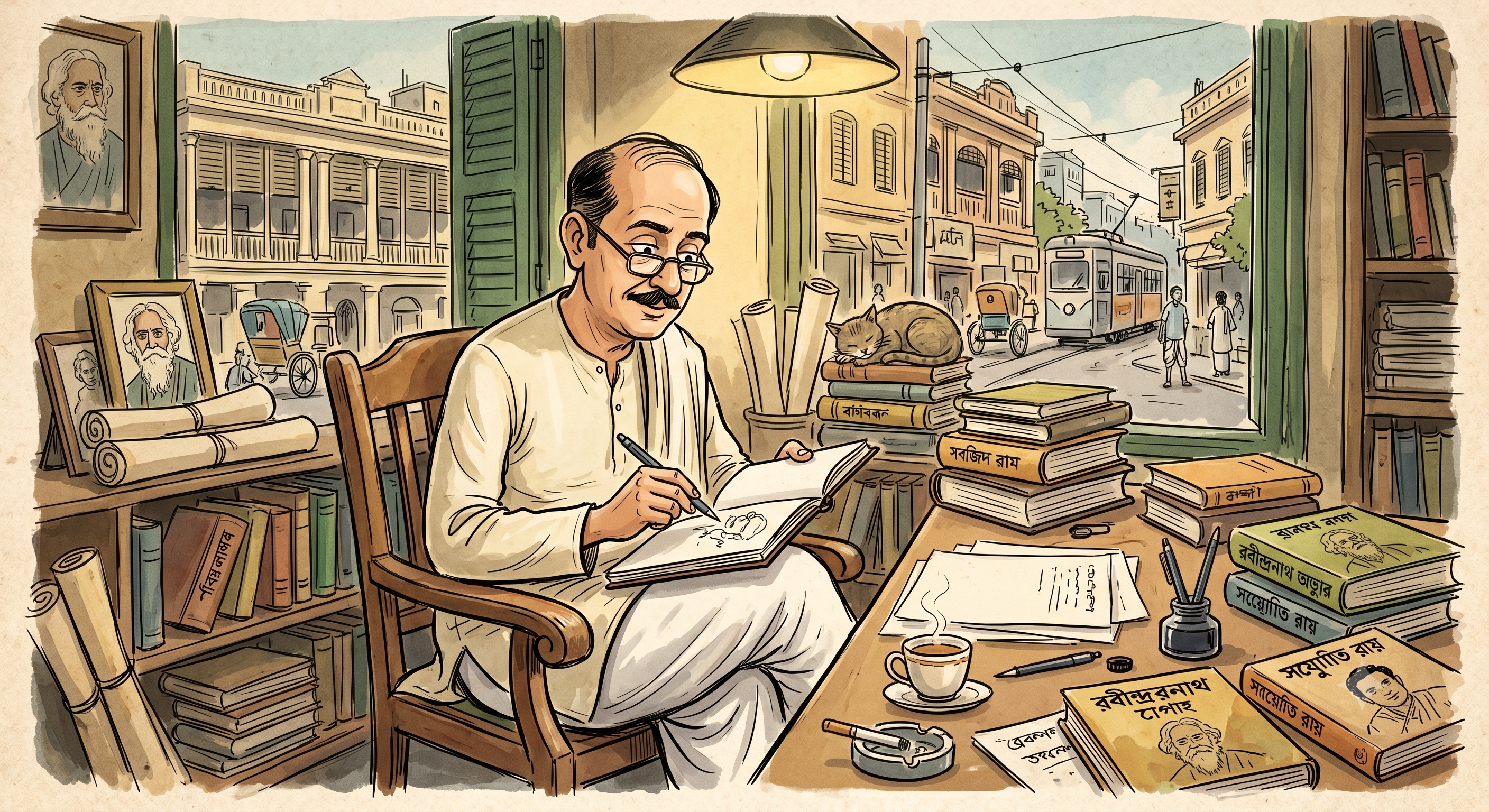
He has opinions about literature (Tagore is transcendent, everything after Manik Bandopadhyay is a decline, contemporary Bengali fiction is "commercial"), about politics (the current government is corrupt, the previous government was also corrupt but more cultivatedly so), about food (the fish from this particular market is superior to the fish from that particular market, and he will explain why at a length that outlasts the fish), and about Kolkata (it was better before, it will not improve, but it is still the only city worth living in, a position he maintains while applying for a visa to his nephew's apartment in New Jersey).
He does not have opinions about caste, because Bengal has no caste. He will explain this to you at length. The explanation will be delivered in a tone of gentle condescension toward lesser states — by which he means all of them — where caste apparently does exist. That Bengal has the second-highest Scheduled Caste population in India is a statistic he has not encountered, or has encountered and set aside, like a book he means to get back to.
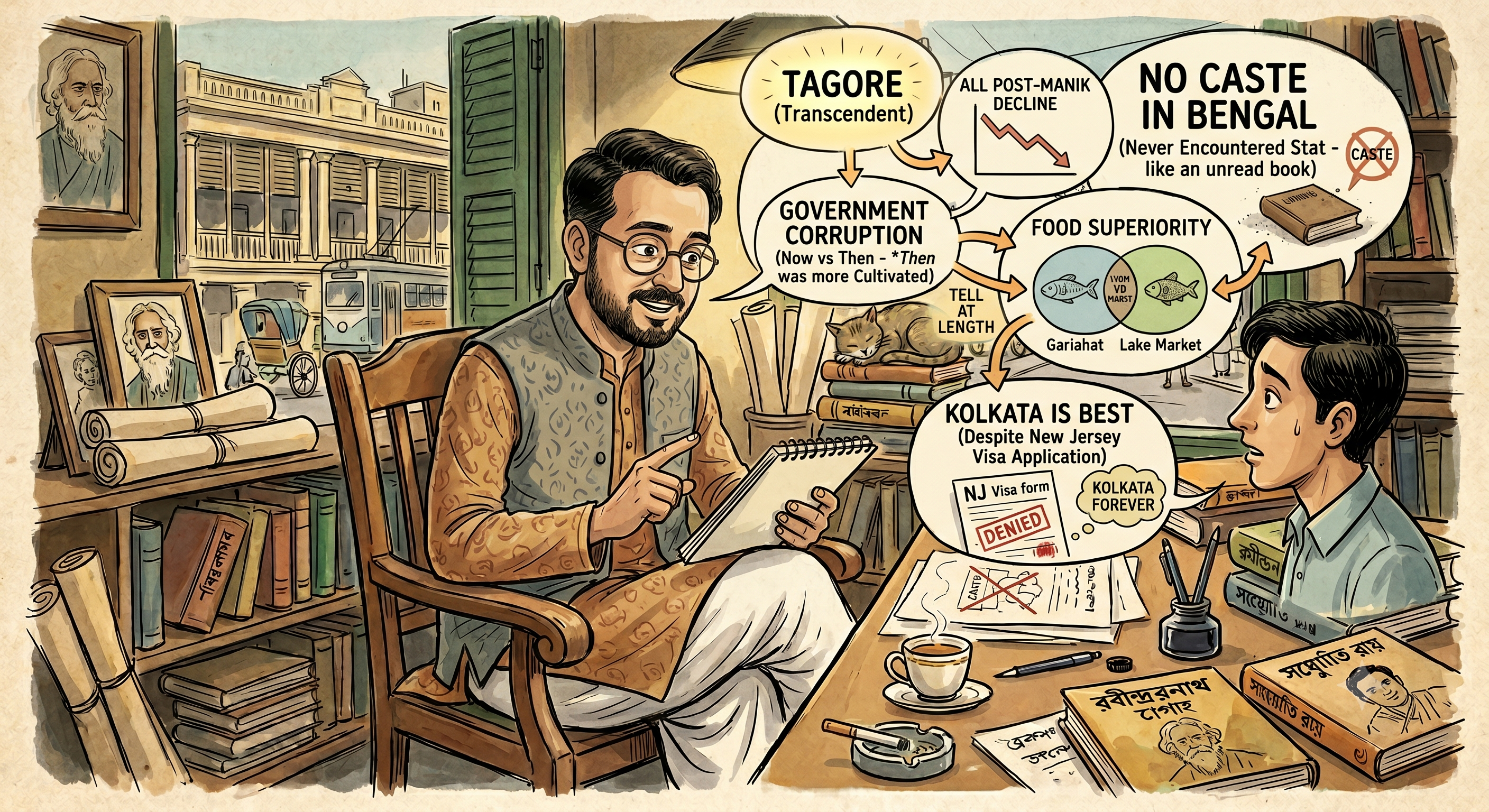
The Indian Coffee House on College Street is the Bhadralok's natural habitat, his watering hole, his parliament. Here, over small cups of tea gone cold, empires of the mind are built and demolished daily. No subject is too large to be resolved by 11 AM.
The conversations follow a recognizable structure. Someone says something. Someone else disagrees. A third person quotes Gramsci. A fourth person corrects the quotation. The first person now disagrees with his own initial position but frames it as a synthesis. Everyone agrees that Mamata is terrible. Everyone agrees that the BJP is worse. Nobody agrees on anything else. Two hours pass. The tea is still there, cold, unpaid for.
No action results from any Coffee House conversation. This is not a failure. This is the point. The Bhadralok understands, at a cellular level, that thinking about a problem and doing something about it are very different activities, and that the former is in every way superior.
The Bhadralok is not opposed to work. He is opposed to certain kinds of work — specifically, the kind that involves making things, selling things, or dirtying one's hands in the business of production and exchange. These are activities suited to Marwaris, Gujaratis, or other commercially inclined peoples who have not yet grasped that the life of the mind is its own reward and also somewhat more dignified.
The appropriate professions are: university lecturer, government employee, journalist, doctor, lawyer, and — for those with genuine flair — impoverished poet. The Bhadralok entered the professions in such numbers and so early that, by the time independence arrived, West Bengal had more lawyers than factories. He regards this as evidence of civilization.
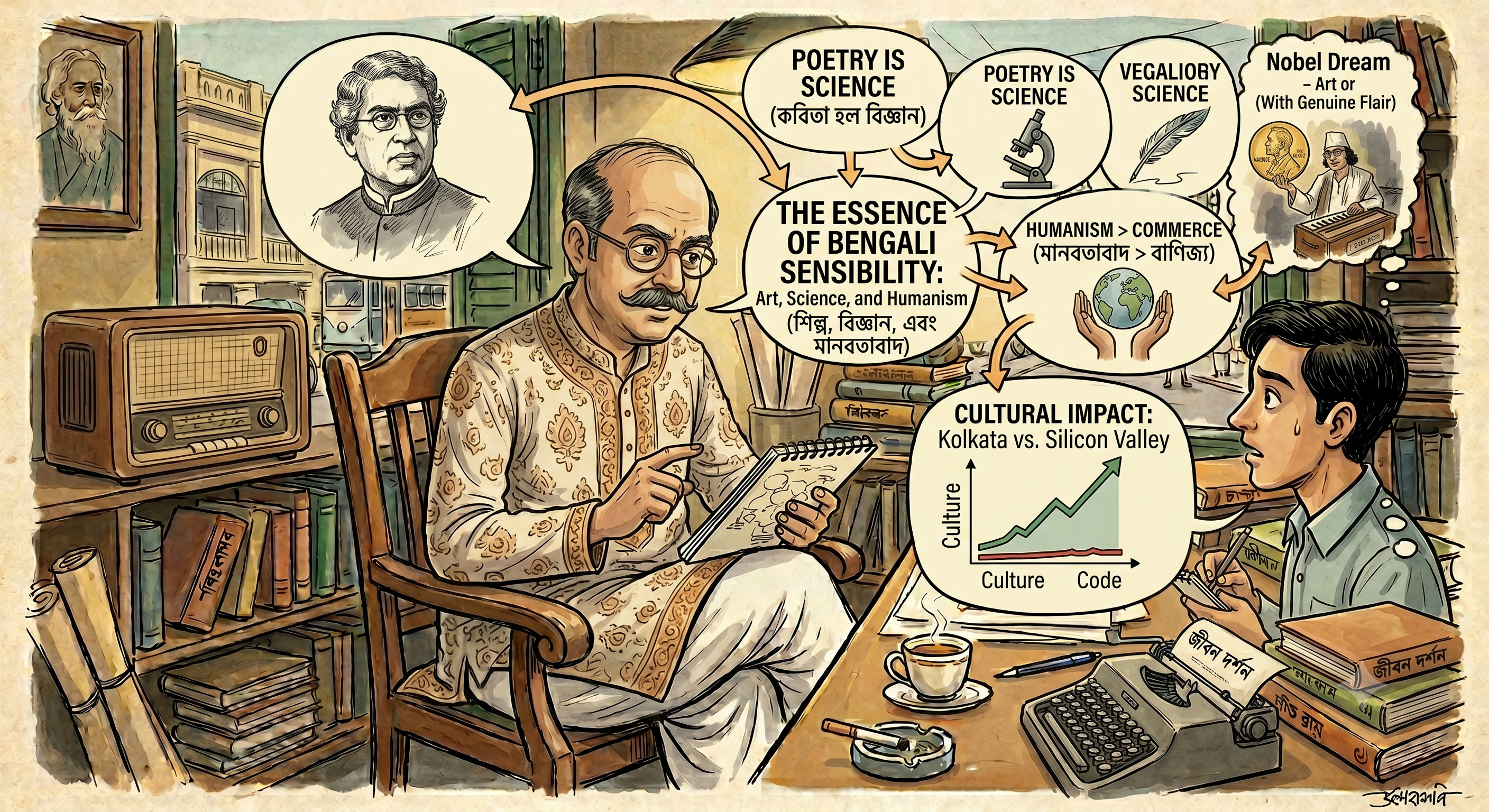
When the factories that did exist began to close in the 1970s and 1980s — due, depending on who you ask, to either militant trade unionism or corporate malice, the Bhadralok having opinions on both sides — he observed this with the philosophical detachment of a man who never worked in a factory and doesn't intend to start.
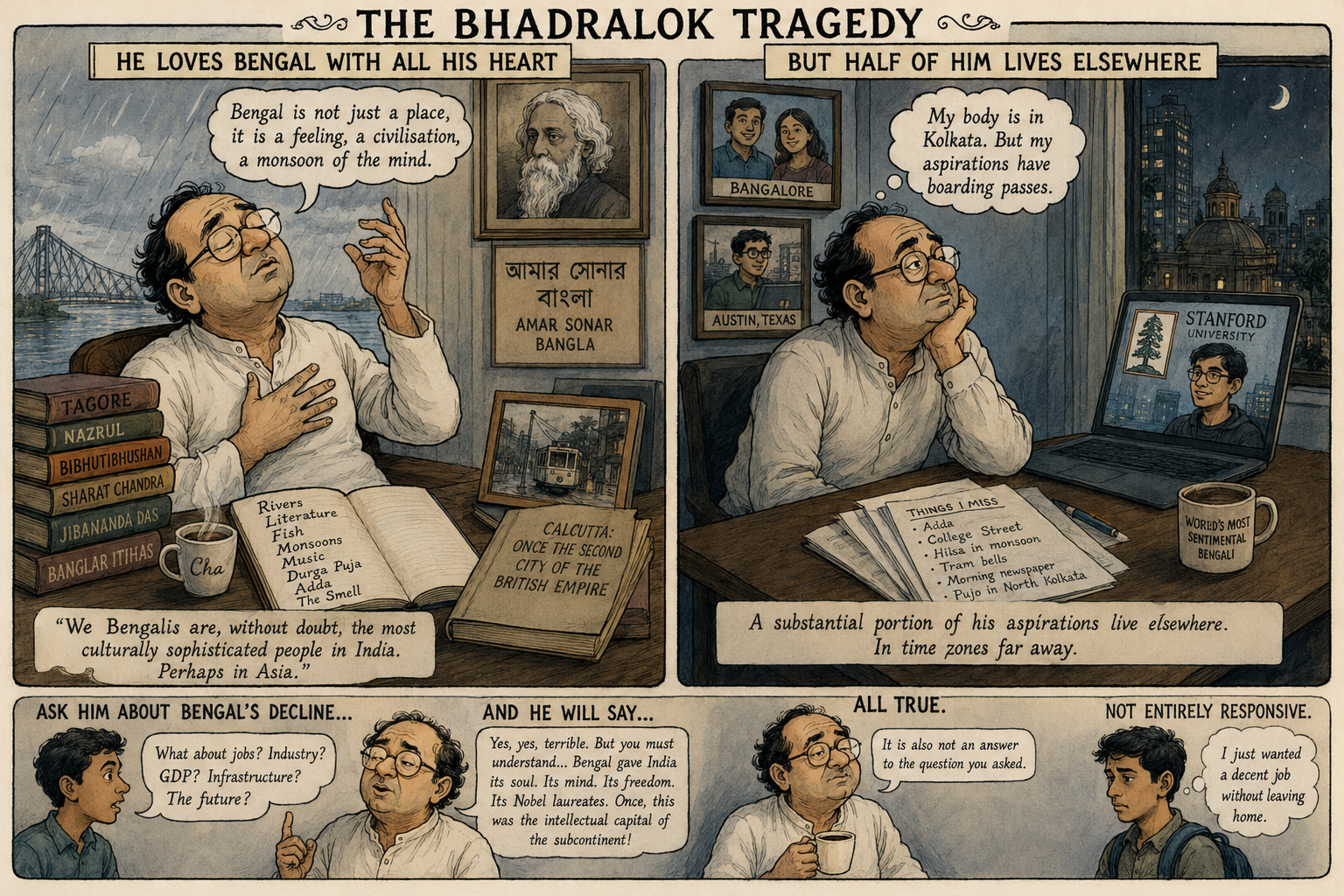
The Bhadralok loves Bengal with a ferocity that makes ordinary patriotism look lukewarm. He loves its rivers, its literature, its fish, its monsoons, its music, its Durga Puja, its intellectual tradition, its very smell. He will tell you that Bengalis are the most culturally sophisticated people in India, possibly in Asia, and he will do this without irony, at a dinner party, to a Tamilian.
And yet he does not quite live there. Or rather: his body lives in Salt Lake or Behala or Garia, but a substantial portion of his aspirations live elsewhere — in the careers of children settled in Bangalore, in the American universities where his grandchildren are studying computer science, in the fantasy of a Bengal that existed, in its fullest form, sometime around 1905 and has been in dignified decline ever since.
He responds to this gap between love and departure by feeling sad about it in an extremely articulate way. Articulate sadness is the Bhadralok's highest art form. Tagore practically invented it. The Bhadralok has been practicing it ever since.
Ask the Bhadralok about Bengal's economic decline — the industrial stagnation, the brain drain, the GDP figures, the infrastructure — and he will say: yes, yes, terrible, but you must understand that Bengal was the intellectual capital of the subcontinent, that it gave the nation its literature and its freedom movement and its Nobel laureates, that Kolkata was once the second city of the British Empire.
This is all true. It is also, if you are a young Bengali who cannot find decent employment and must migrate to Hyderabad to work for an IT company, not entirely responsive to the question you asked.
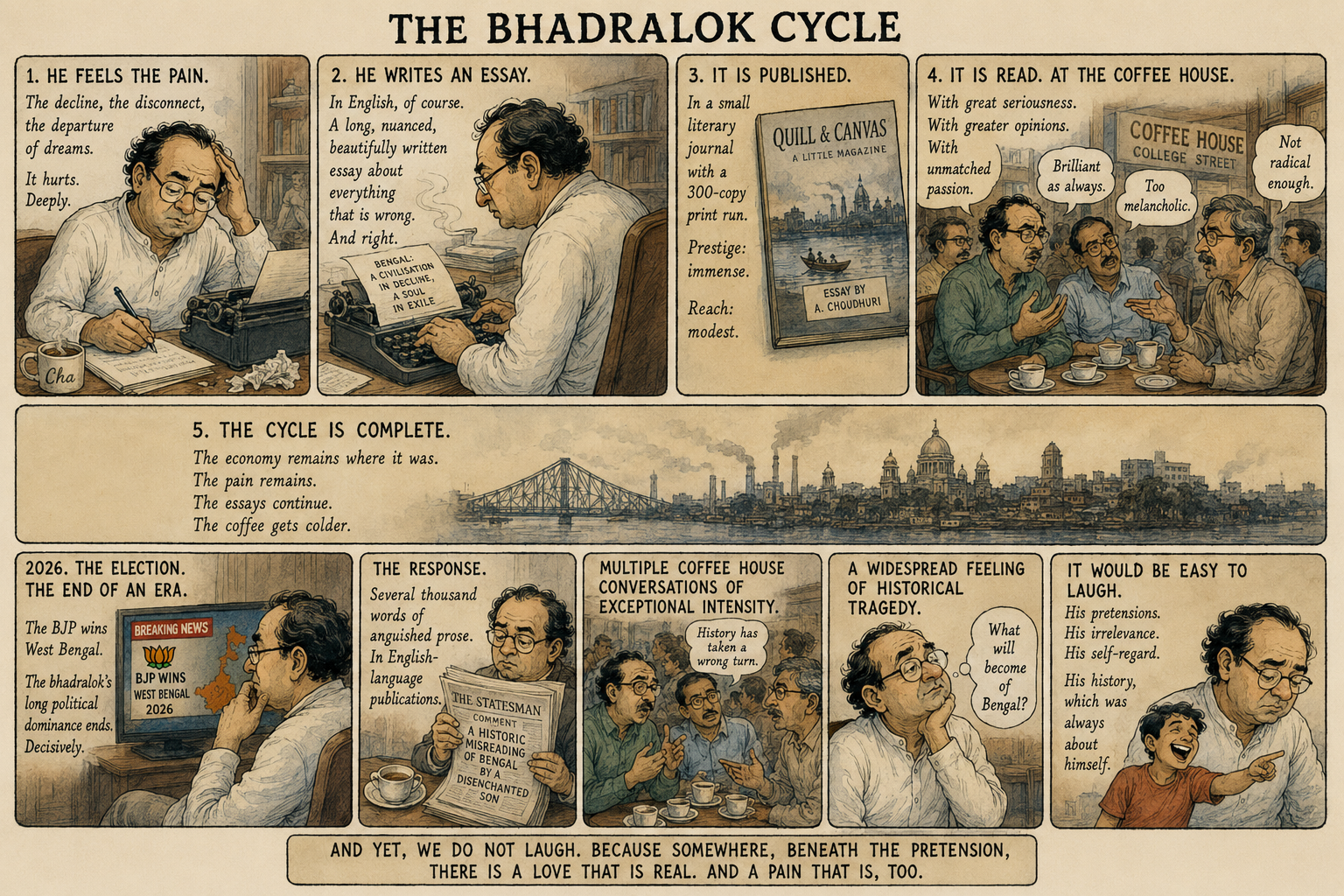
The Bhadralok suspects this. He finds it painful. He processes the pain by writing an essay about it, which is published in a small literary journal, which is read by other Bhadraloks at the Coffee House, where they have opinions about it. The cycle is complete. The economy remains where it was.
The 2026 election, in which the BJP won West Bengal and the Bhadralok's long political dominance was decisively ended, has produced a characteristic response: several thousand words of anguished prose in English-language publications, multiple Coffee House conversations of exceptional intensity, and a widespread feeling that history has taken a wrong turn.
It would be easy to laugh at the Bhadralok. His pretensions, his comfortable irrelevance, his magnificent capacity for self-regard, his discovery that the history he was writing all along was actually about himself.
But consider what he produced, in his heyday, in his Bengali Renaissance moment, in the long extraordinary century between Rammohan Roy and Satyajit Ray. He produced Tagore. He produced the first great Indian novel, the first great Indian film, some of the first sustained Indian thinking about science, women's rights, caste, and the nature of modernity. He produced, from a small, rain-soaked city at the mouth of the Ganges, a literature that the world is still reading.
He produced all of this, and then he retired to his Coffee House, ordered a small tea, and began explaining to anyone who would listen why everything since has been a disappointment.In this, at least, he is not entirely wrong.
(The author wishes to acknowledge that this piece was written in a café in Bengaluru, over a cup of tea gone cold, while avoiding a more pressing deadline. She does not consider this relevant).
Note:(pics from internet for illustration only)

-SunheriSufi
Comments (7)